About
Allison Yost, PhD
Organizational psychologist, executive leader, and researcher. Through coaching, workshops, tools and writing, I help thoughtful people work through meaningful transitions and reclaim authorship over their own direction, both at work and in the ordinary moments most people overlook.
Why I Do This Work
I’ve spent most of my life fascinated by a set of questions: What helps people thrive? What creates well-being? What makes a life feel meaningful, not just successful? And what can we actually do, in the ordinary structure of our days, to cultivate more of that?
Those questions are why I became a researcher and psychologist. I wanted better answers than the ones we usually get from tips, trends, and whatever happens to be popular at the moment. Human beings are complex. Our lives are complex. And I’ve always been drawn to research because, at its best, it gives us better clues about what actually helps people grow, change, lead, and live well.
Work became a natural place to study those questions because work takes up so much of adult life. It shapes our identity, our relationships, our energy, and our sense of contribution. For many people, work is where questions of meaning, ambition, burnout, and purpose all collide. That is what led me to pursue a PhD in industrial-organizational psychology: the study of people at work, and the conditions that help them perform, grow, and thrive.
But the questions were never only about work. They were about life.
That question first became real for me while trying to decide between graduate programs after college. It was a high-stakes decision, and I was completely stuck. On paper the choice looked obvious: one program was ranked at the very top of the country for what I thought I wanted to do, and the other was a more unconventional path without the same prestige. Everything external pointed one way, but something kept pulling me toward the other.
The next time I went home, my mom sat down with me at the kitchen table and spread out a series of index cards, one for each possible path. Together we mapped out not just the immediate choice, but what each path would open up, close down, and cost over time.
There was no judgment or pressure. But with the full landscape of the decision laid out in front of me, I could actually make sense of it. I realized I had been treating it as a binary choice when it really wasn’t.
Once I could see the whole picture, I realized I didn’t have to give up one option for the other: I could pursue what I valued in both, even though it would be an unconventional path. I knew it would raise some eyebrows, but I felt confident that it was more aligned with who I was and what I cared about, and remains one of the best decisions I’ve ever made. And as it turned out, this choice that looked riskier on paper is the one that ended up opening the most doors.
That experience stayed with me. What helps people see more clearly when the stakes are high? What creates the conditions for someone to hear what they already know?
Years later, those questions became personal. At one point in my career, I found myself in a chapter that should have fit better than it actually did. Meaningful work, significant responsibility, people I deeply respected. I wasn’t burned out, and I wasn’t miserable. But something wasn’t quite right, and over time I started to feel like the path I was on was taking me further from something important. The problem was that I couldn’t yet name what that something was.
Giving up a trajectory that offered stability, purpose, and real excitement for something completely unknown felt like an enormous risk. So I did what a lot of people do: I stayed busy and hoped the feeling would pass.
It didn’t.
Fortunately, I started working with a coach. Like many people facing a significant transition, I initially focused on what wasn’t working: where I felt drained, what felt misaligned, what I was ready to move away from. My coach didn’t offer answers. She helped me ask better questions.
Together we explored my strengths, values, and the experiences that consistently gave me energy and even joy. One of the most important discoveries was recognizing that many of my greatest strengths center on helping other people grow. Listening deeply. Seeing potential. Creating clarity. Helping people navigate complexity and change.
That insight led somewhere unexpected. The answer wasn’t to walk away from leadership or contribution. It was to find a way of contributing that fit better with who I am and what I love to do.
That realization helped me imagine a future that included more time with my family, more space for creativity, and a path toward work that made better use of my strengths. The answers didn’t all emerge at once, but I gained something just as valuable: direction. And I’ve learned that when we’re navigating uncertainty, direction and a willingness to experiment often matter more than certainty.
Through this, I learned that real security doesn’t come from a job, a title, or a system’s promise of stability. It comes from knowing you’re the one holding the pen, even when the circumstances aren’t fully yours to choose. The same decision can be made from a place of fear or a place of principle, and the difference shapes everything that follows. This distinction matters even more now, in a world where the old anchors (job, status, approval) are less reliable than they used to be.
Looking back, I can now see that coaching had given me the same gift I’d received around that kitchen table. It helped me see a larger landscape of possibilities. It helped me reconnect with what mattered most. It helped me move forward with more calm, clarity, and connection than I could have found on my own.
That’s the work I do now, through coaching.
I stopped asking what I wanted to leave behind. I started asking what I wanted to create.
The reframe that changed everything
What I’ve Learned
After years of studying human behavior and living through my own significant transitions, a few things have become clear.
People don’t need to be told how to live or what decisions to make. They need space, honest reflection, and the right questions to hear what they already know. The wisdom is almost always already there. It gets buried under expectations, obligations, fear, and the relentless noise of a busy life.
The most important decisions rarely come down to choosing between Option A and Option B. They open up when you can see a larger landscape and reconnect with what matters. The work isn’t about making a choice. It’s more about gaining enough clarity to choose well, and identifying the practical next steps that move you closer to what you’re trying to build.
But clarity is only part of it. Seeing the aligned path and walking it are two different things, and the choice that’s right for you is often the one that looks unconventional on paper. That takes courage, and it’s far easier to find when someone is beside you, helping you honor what you’re seeing and stand up for the version of yourself that’s trying to emerge.
Significant transitions, even difficult ones, often create the conditions for the most meaningful growth. Transitions force questions to the surface that a comfortable life allows us to avoid: What do I actually want? Who am I becoming? What do I want to create with the precious time I have on this planet?
And the shift that has made the most consistent difference: moving from asking what you want to leave behind, to asking what you want to build. That single reframe can change everything, as it did for me.
Professional Background
Research and Training
I have a doctorate in industrial-organizational psychology, a master’s in applied statistics and psychometrics, and nearly two decades of experience studying human behavior, motivation, leadership, and well-being.
My work has centered on what helps people, leaders, and teams thrive. I’ve studied performance, motivation, leadership, and well-being, and the deeper I’ve gone, the more connected those questions have become. The highest-performing leaders and teams are rarely just better at execution. They are often more grounded, more self-aware, more values-aligned, and better able to make clear choices under pressure.
Leadership Experience
I’ve also lived these questions from the inside, in leadership roles where the pressure of high-stakes decisions and the hidden cost of carrying more than people around you can see were part of daily life.
That experience shapes how I do this work. I’m not interested in abstract advice or generic encouragement. I care about the deeper work underneath leadership and transition: clarity, courage, values, identity, and the practical choices that turn insight into a life that feels more true.
BetterUp
In my current executive role, I work at the intersection of behavioral science, technology, coaching, and human development. That work has deepened my respect for the conditions that help people grow: trust, reflection, skilled questions, and space to hear what they already know.
It has reinforced something I believe deeply. People are not empty vessels waiting to be filled with advice. The wisdom they need is almost always already inside them. The right questions, held in the right space, help them hear it more clearly and act on it with more courage.
Across all of it (the research, the leadership roles, and the work I do today), I keep returning to one question: what helps people thrive in the modern world? At BetterUp, I explore how organizations can create the conditions for people to thrive at scale. In my coaching, I take up the same question one person at a time: how individuals thrive inside and outside of work, even when a job or organization can’t provide all of those conditions. Work is one of the most powerful contexts for human growth, but it was never meant to be the only container for a thriving life. These two vantage points keep deepening each other.
The making happens at Coppermine Studio, my product studio, where I build reflection tools, and eventually workshops and other useful things, for people designing their next chapter. This site is where I coach and write. Coppermine is where I make.
Beyond Work
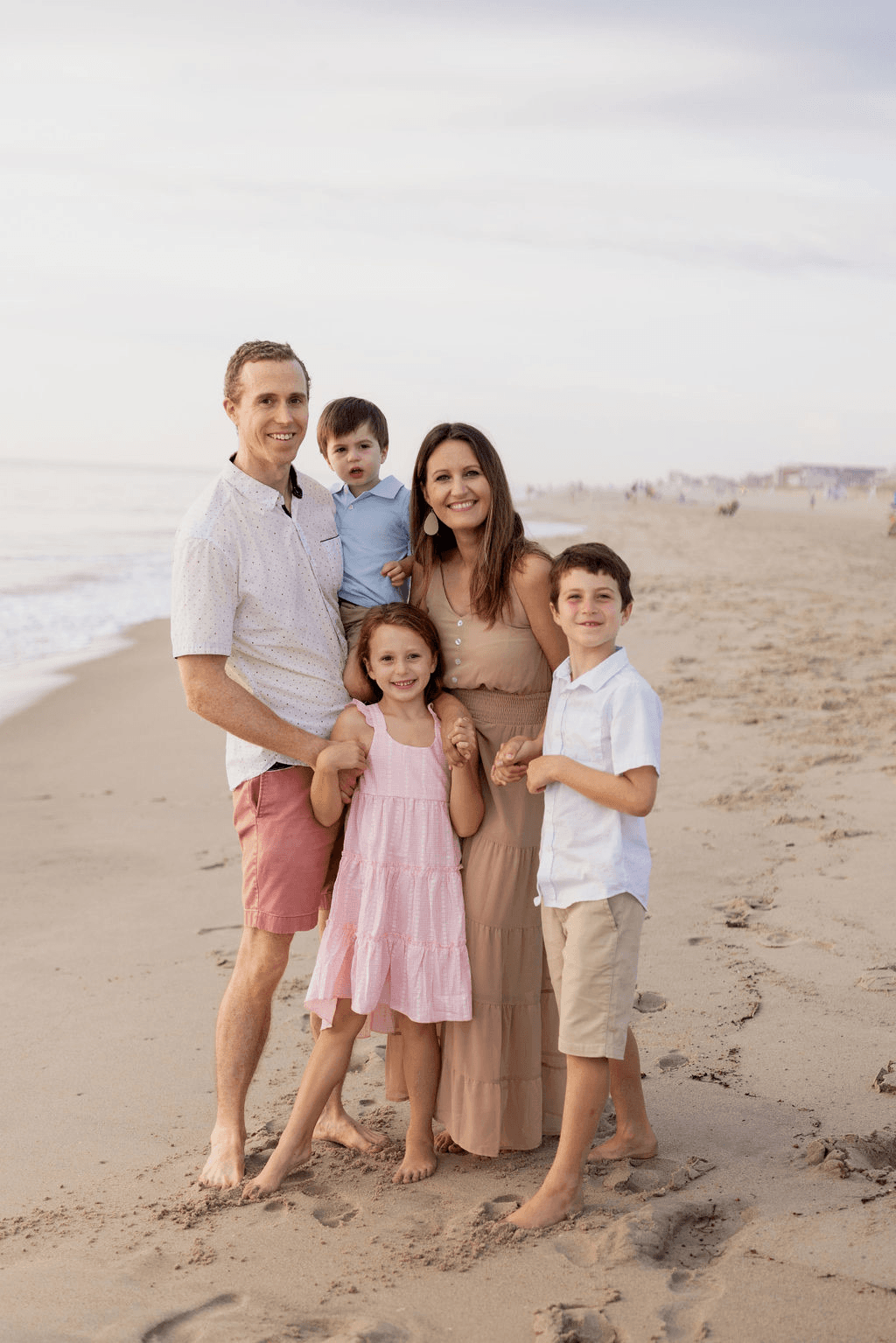
Allison lives in Arlington, Virginia with her husband Kevin, their three children, and two dogs. Outside of work and family life, she enjoys reading, writing, sketching, painting, and building creative projects with her kids, some of which live at CoppermineKids.com.
If you’re standing at a threshold and trying to understand what comes next, I’d be glad to help.
Book a 30-Minute Intro Call